Tracking the Venezuela Conversation in U.S. and Venezuela WhatsApp and Telegram Groups Over the Course of 72 Hours
Since the U.S.’s incredibly viral extraction and arrest of Nicolás Maduro on Jan. 3, 2026, an ongoing debate has unfolded in English and Spanish in the spaces where there are few “editors,” no algorithmic feed, and no single narrative in control – on WhatsApp and Telegram public groups.
To complement the rapid global analysis on Whatsapp and Telegram DDIA did of English and Spanish discussions in the first 12 hours, DDIA today highlights discussions that took place in the last 72 hours, this time specifically within WhatsApp and Telegram groups with area codes based in the United States and Venezuela, the two countries whose citizens are arguably the most impacted by what comes next.
WhatsApp 72 Hours
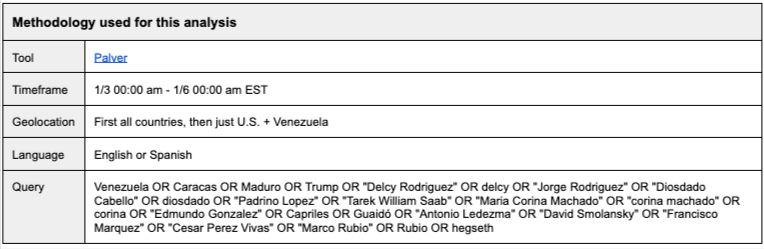
Drawing on 4,000 unique WhatsApp posts shared across more than 175 public groups – with a potential reach of at least 63,000 English- and Spanish-speaking users in the United States and Venezuela – DDIA mapped a timeline of dominant narratives in the U.S. and Venezuela.
The analysis shows that in both languages and countries, discussion of the intervention moved quickly from theatrical, tactical, play-by-play accounts to more complex debates about legality, governance, and political transition.
In the first 12 hours the conversation centered on the actors and the special effects of the military extraction: the helicopters, the explosions, and the physical arrest, which in President Donald Trump’s own words played out “like a television show,” driven by videos over Caracas, a photo of Maduro in a Nike sweatsuit alongside various AI-generated ones, and photos of the dictator being escorted into a New York courtroom.
Over the course of 72 hours, the conversation shifted to who would run the show: the "Rubio-Hegseth Transition Team" and the U.S. oil companies who would supposedly spend millions of dollars to "fix" the country. Over this period, at least in the public groups, we noted that:
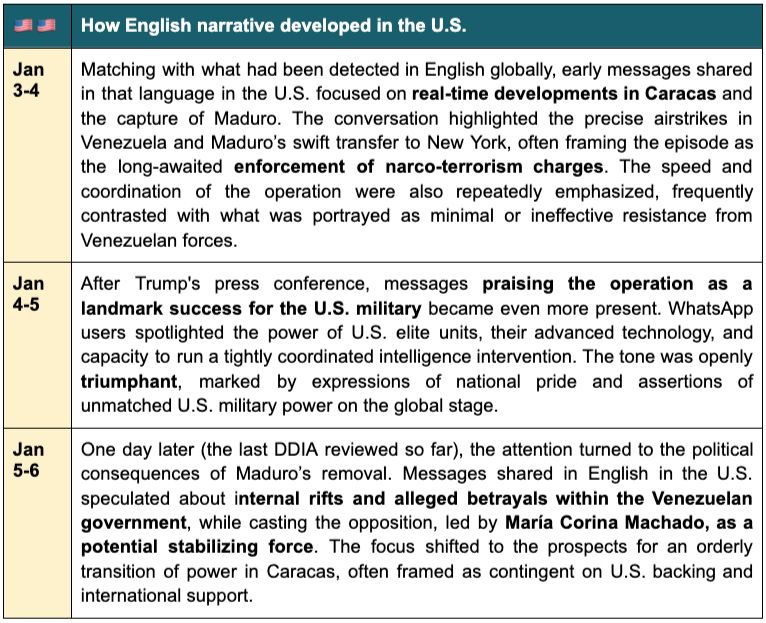
U.S.-based discussions in English were largely supportive of Trump and his operation;
U.S.-based discussions in Spanish largely focused on concerns about the transition; and
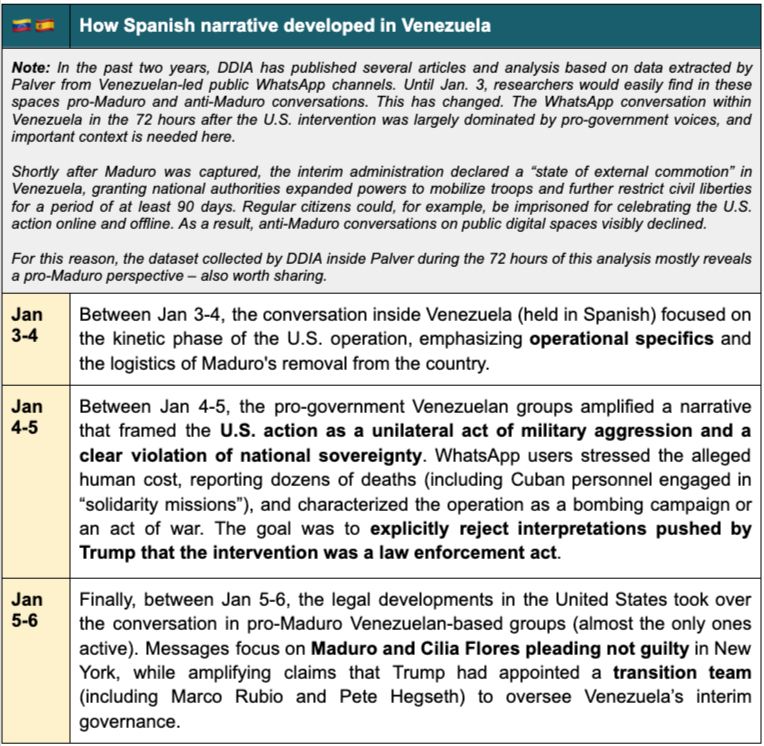
Venezuela-based discussions in Spanish were dominated by pro-Chavismo discourse (likely in part because the Delcy Rodriguez interim government of Venezuela declared a “state of external commotion” that would land critics in jail).
Here is how discussions broke down between the languages and countries in further detail:

Telegram 72 Hours:
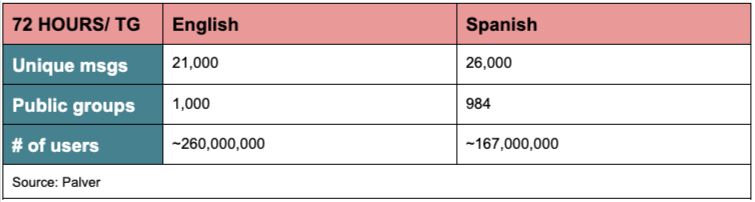
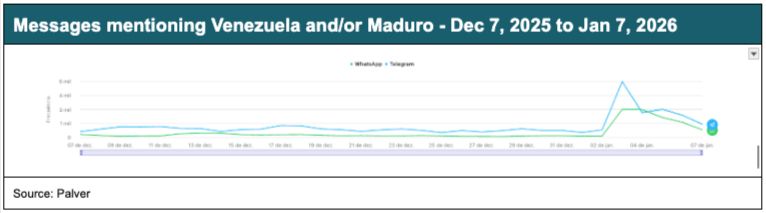
Between January 3 and 6, 2026, Palver collected 47,000 unique messages posted in English or Spanish across 1,984 public (global) channels. According to the tool (that does not offer in-country details related to Telegram), these messages might have collectively reached more than 427 million members worldwide.
Based on 200 unique messages (among the most viral ones), DDIA researchers identified three cross-cutting narratives regarding the situation in Venezuela.
The Nobel Prize Became a Proxy for Power Politics: In English-language channels, discussion of the Nobel Peace Prize awarded to Maria Corina Machado and the Venezuelan people – and Machado’s comments about possibly sharing it with President Donald Trump – quickly turned into a test of opposition-U.S. alignment. Supportive voices framed the gesture as symbolic unity against authoritarianism. Critics, however, argued it backfired, speculating that Trump resented the move and might distance himself from Machado in shaping a transitional government.
Maduro’s Arrest Opened a Debate About Who Governs Next: Across both languages, Maduro’s capture and court appearance in New York triggered competing interpretations. U.S.-aligned accounts described the episode as a landmark law-enforcement action, while pro-Maduro voices cast him as a “kidnapped” prisoner of war. At the same time, Telegram users speculated that, for now, Washington might bypass traditional opposition leaders in favor of Vice President Delcy Rodríguez, portrayed by some as a pragmatic interim partner capable of protecting U.S. strategic – especially oil – interests.
Fear of Escalation Fueled Regional and Global Narratives: A third cluster of messages focused on backlash and the risk of wider conflict. English-language channels amplified protests in U.S. cities accusing Washington of “war crimes,” alongside warnings from regional leaders. In Spanish-language groups, these concerns expanded into global conspiracy narratives, including claims of Kremlin retaliation and the so-called “Putin Trap” theory – the idea that the Venezuela crisis was engineered to distract from other global flashpoints, particularly the war in Ukraine.