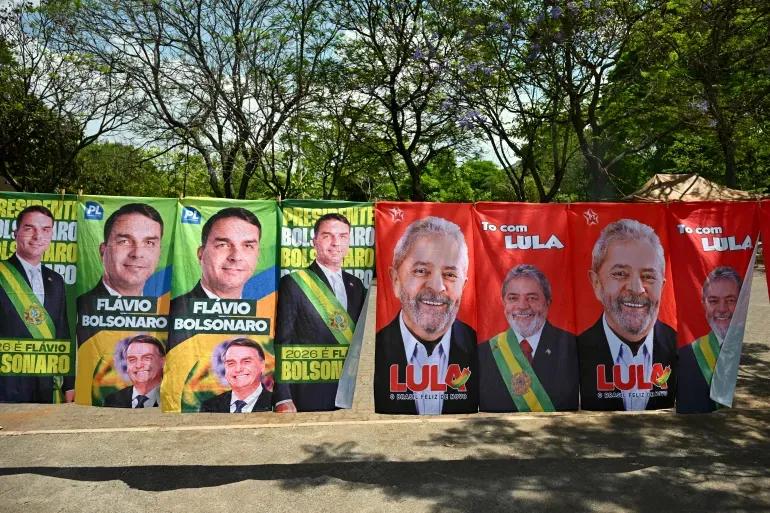
Ten Questions and (Easy-to-Digest) Answers About the 2026 Brazilian Elections
Is there U.S. interference in Brazil’s elections? If so, what does it look like?
There are clear patterns showing political and public pressure from the United States on Brazil, in the form of retaliatory tariffs, sanctions against Brazilian officials, ideological networks that amplify one another, and Trump-backed online and offline commentary that overlaps with the interests of the Bolsonaro movement. Some Trump-aligned organizations, influencers and politicians clearly bolster the Bolsonaro movement. That alone does not establish direct U.S. interference in Brazil's elections.
Outside of public support and social media amplification of far-right narratives online, as of October 2, there is no meaningful evidence showing that Washington is secretly controlling or manipulating Brazil’s elections. The U.S. echoes the far-right’s narratives in Brazil and vice versa, but Brazil’s election outcomes will be a result of complex domestic political dynamics that should not be attributed primarily or exclusively to the Trump Administration’s influence.
It would be naive to claim, however, that the U.S. has no influence on what happens in Brazil. Bolsonaro supporters in Brazil revere Donald Trump. And Trump knows how to throw his weight around to bolster support for the candidates he agrees with ideologically.
In 2025, President Trump explicitly linked a 50% tariff on Brazilian goods to what he called the unfair treatment of Jair Bolsonaro (arrested for a coup attempt) and demanded that Bolsonaro's criminal case be thrown out. His administration also imposed financial sanctions on Supreme Court Justice Alexandre de Moraes, who was overseeing Bolsonaro's case.
That close Trump-Bolsonaro relationship has continued into the 2026 campaign. Flávio Bolsonaro, Jair's son and now one of the two leading candidates, met Trump in the Oval Office in May 2026. And while Trump has not issued an explicit endorsement of Bolsonaro Jr. in the week leading to the first round of voting (he said only that he was following the Brazilian election "very closely”), new information came to light this week that is worth scrutinizing.
Reporting from the U.K. this week says the Trump Administration has considered roughly $1 million in U.S. State Department funding for initiatives challenging Brazil's Supreme Court, prompting Brazil's attorney general to open an investigation into possible foreign interference. Separately, Brazilian newspaper Folha de S.Paulo documented how a far-right leaning U.S.-based network called Rockbridge was interested in influencing the outcomes of the election.
Though Brazilian law restricts foreign support and third-party paid promotion of candidates, it is clear that in today’s information ecosystem, the blurring of those lines is possible and even likely.
Read more of our coverage on this here:
https://ddia.org/en/brazil-election-what-role-is-washington-playing
How did a country with so many candidates and political parties in 2026 end up with a Lula - Bolsonaro-dominated contest?
Brazil has 13 candidates running for president in 2026, and 30 registered political parties, yet the two leading candidates (President Luiz Inácio Lula da Silva (PT) and Senator Flávio Bolsonaro (PL)) account for more than 80% of voting intention.
The roots of this consolidation go back at least to the very close 2014 Dilma Rousseff - Aécio Neves election, followed by challenges to the result, Dilma's impeachment, the Carwash Operation, Lula's imprisonment and return to electoral politics, Bolsonaro's rise, the highly polarized 2018 and 2022 elections, and the January 8, 2023 attacks on government institutions.
Over the last decade, Brazilian politics has organized itself around two political identities, more so than around political parties. These include the camps of Lulismo/anti-Bolsonarismo and Bolsonarismo/anti-Workers’ Party (PT).
Both Lula and Bolsonaro have built something that functions increasingly like a political brand or movement rather than a political party. That leaves a lot of room for cult of personality, values, and identities to dominate conversations. Combine that with deep frustration and distrust of the establishment and an information ecosystem that rewards shock and emotion, and we see Brazilians standing for persona more than policy across the political spectrum.
What can we say about the first and possible second rounds of voting?
The first round of voting will take place this Sunday, October 4. A candidate must receive more than 50% of valid votes to avoid a runoff. If neither does, the two candidates receiving the most votes advance to the second round on October 25.
Across the latest major surveys, Lula and Flávio are far ahead of the remaining candidates. Datafolha's latest valid-vote estimate is 45% Lula and 40% Flávio. Quaest's September 28 survey had Lula at 39%, Flávio at 34%, Augusto Cury and Ronaldo Caiado at 4%, Renan Santos at 3%, and Romeu Zema at 1%.
Lula and Bolsonaro are the most likely to advance to a second round. In that scenario, a meaningful pool of voters who are undecided, persuadable, considering smaller candidates, or contemplating sitting out or voting blank will be key for shaping this election. DDIA expects those voters may cast their second-round ballots in favor of a right-leaning candidate because many of the other candidates counting with some percentage of support in this race identify with the right.
Who safeguards elections in Brazil? What are the checks and balances?
Brazil has a pretty centralized electoral justice system. The Superior Electoral Court (TSE) administers national elections. Beneath it are the regional electoral courts (TREs) and local electoral judges. There is also the Electoral Prosecution System, that runs independently from any other branch of power.
But Brazil’s elections also count with many layers of inspection, testing, auditing, party participation and independent observation, and a much wider group of stakeholders also play a role in scrutinizing both the process and the voting machines Brazilians use to cast their ballots.
In 2026, these stakeholders include political parties and coalitions, the Federal Police, the Public Prosecutor's Office, the Brazilian Bar Association, Congress, the Federal Court of Accounts and Brazilian Computer Society, among others. Notably, the source code for the 2026 voting system has been open to authorized inspection since October 2025, one full year before the election. (Read more about the voting machines below.)
Brazil also welcomes electoral observation missions. The Organization of American States (OAS) has deployed nearly one hundred observers across the Federal District and 20 states for 2026, its largest mission ever in Brazil. The European Union and several other international organizations are also participating.
We’re hearing claims that Brazil’s judiciary is interfering in the election. What are the legitimate concerns, and what is being exaggerated or misrepresented?
This question requires a lot of nuance that goes beyond the dichotomy of "the courts are censoring everyone" or "there is nothing to see here." Brazil is having many legitimate institutional debates about the role of the judiciary in the electoral process.
Brazil gives its electoral judiciary considerably more authority over campaign rules and online political speech than would generally be constitutional in the United States. Courts can and have ordered social media content removed, sanctioned campaigns and platforms, adjudicated candidate eligibility, and enforced rules against electoral disinformation. While many claim otherwise, recent 2026 enforcement has not fallen neatly along partisan lines.
Beyond the online world, this year there is a real institutional dispute over the boundary between the electoral court (the TSE) and the supreme court (the STF). TSE President Kassio Nunes Marques formally complained in September about possible overlapping jurisdiction, while the STF maintains authority to review constitutional questions arising from TSE decisions.
All of these questions are legitimate rule-of-law and free-expression questions. What is misleading is jumping from those controversies to the conclusion that the judiciary therefore controls election results or that the vote itself is fraudulent.
What election-fraud narratives should we be watching for?
As DDIA has long shown, election-fraud narratives get recycled and repeated across elections and country contexts. The strongest clues for what we are seeing / are likely to see in 2026 come from the 2022 playbook.
In 2022, narratives included claims that electronic voting machines secretly changed or deleted votes, that particular models of machines were unreliable because they were produced abroad (mainly Venezuela), that the TSE has been hiding evidence of fraud, that the judiciary was conspiring against Bolsonaro, and that international actors or technology companies were helping determine the result of the elections. Following Sunday’s vote, and ahead of the second round, DDIA recommends watching for some of the same claims that generally fall under the meta-narrative that elections are fraudulent and can’t be trusted.
These may look like claims that Brazil’s voting machines are rigged, that the courts stole the election, that polls were fraudulent, that votes disappeared, or that Brazil’s establishment (especially the Judiciary) prevented the real winner from taking office.
As research shows , fraud narratives often begin before results are affirmed, making prebunking especially useful. Explain beforehand what normal vote counting looks like, what audits exist, why polls can differ from results, and what constitutes actual evidence of fraud.
Can Brazil’s electronic voting machines be trusted? What safeguards are in place?
Brazil’s electronic voting machines are trustworthy. The country has used electronic voting machines since 1996. Unlike the United States, Brazil does not use paper ballots for ordinary voting or offer mail-in voting. Voters cast their ballots in person on dedicated machines protected by multiple layers of testing and auditing.
The key point is that the voting machines are not connected to the internet while votes are being cast. Votes are stored locally, and the machines are purpose-built exclusively for elections.
Security checks begin before Election Day. Authorized institutions can inspect the voting software, and outside researchers participate in public tests designed to find vulnerabilities. Officials also use digital signatures and cryptographic verification to confirm that machines are running authorized software. Political parties, prosecutors, the Brazilian Bar Association, and other institutions can participate in or observe audits.
On Election Day, the process works as follows:
Before voting starts, each machine prints a zerésima, or “zero report,” showing that no candidate has any votes recorded.
When voters arrive at the stations, poll workers verify that each voter is registered at that location and collect fingerprints to confirm identity and prevent someone from voting as another person.
Voters, then, enter their candidate’s number on the voting machine. The candidate’s name, photograph and party appear on screen, and the voter can confirm (green button) or correct (red) the choice before casting the ballot.
The machine remains disconnected from the internet while ballots are being cast.
When polls close, each machine prints a “Boletim de Urna (BU),” essentially a precinct-level results receipt showing exactly how many votes each candidate received on that machine.
Only after the BU is produced are the results transmitted for aggregation by Brazil’s Superior Electoral Court (TSE). The TSE also publishes the individual polling-station results, allowing parties, journalists, observers and citizens to compare the national tally with the results produced locally.
That last safeguard is particularly important. Thousands of individual machines produce their results before transmission, creating a record that can be compared with the final tally.
Beyond fraud narratives, how has election disinformation in Brazil changed since the 2022 presidential race?
Brazilian election disinformation has become more sophisticated, more focused on undermining trust in elections, and harder to track.
Outright lies have given way to distortions harnessing small grains of truth, as DDIA has noted has also been the case in the United States. Misleading information is more prominent than outright disinformation, in that a lot of what we see is content exaggerating facts, omitting context, or reframing authentic events to mislead.
The target of misinformative and disinformative attacks in Brazil has been expanded to include institutions. Falsehoods used to focus much more prominently on portraying a candidate as corrupt or unfit. Today, we see bad actors online increasingly claiming the election itself cannot be trusted, targeting Brazil’s electronic voting machines, vote counting, results, and the Superior Electoral Court (TSE) or the supreme court itself.
Disinformation has also moved prominently into private messaging. Facebook appeared in 76.5% of Agência Lupa’s election fact-checks in 2018. By 2022, WhatsApp appeared in 92.4% of cases. That shift makes falsehoods harder to detect and correct. Journalists and researchers have a hard time monitoring encrypted conversations, and debunks rarely travel through the same networks as the original claim.
How has Brazil prepared for AI-generated content, and what role is AI actually playing in this race?
Brazil went into its 2026 elections with clear rules for artificial intelligence. AI could be used in electoral content, but candidates, parties and coalitions were required to disclose when material had been synthetically created or altered. Deepfakes (AI-generated images, videos or audio that make real people appear to say or do things they never did) were completely prohibited in official electoral advertising. Yet AI still became a routine part of the campaign.
Between August 16 and September 28, Project VigIA confirmed 920 pieces of AI-generated or manipulated political content, an average of 20 per day, or almost one every hour. Deepfakes were at the center of the problem. About 60% of confirmed cases manipulated or impersonated real people. Transparency was another major challenge. Nearly 60% of the AI content identified by VigIA carried no disclosure that AI had been used.
AI was also used both to support and attack the two leading candidates. President Luiz Inácio Lula da Silva appeared in 379 AI-generated posts, compared with 190 featuring Flávio Bolsonaro. Among posts depicting Lula, 34% attacked him and nearly 25% promoted him. For Bolsonaro, about 40% promoted his candidacy and 27% attacked him.
Brazil will offer the rule broad lessons about the challenges of regulating political AI at scale. While it did have rules in the books leading up to these elections, enforcement has been inconsistent and dispersed.
What role are prediction and betting markets playing in Brazil’s elections, and how might they shape the race?
Prediction markets have become a visible (and often misunderstood) part of Brazil’s election conversation. On U.S.-based platforms such as Polymarket, traders buy contracts based on who they expect to win. As of Friday, October 2, one widely followed market priced Flávio Bolsonaro at roughly 55% and Lula at 45% (numbers might change at any given time).
Those numbers are not polls and do not represent voter preferences. They reflect what traders are willing to pay based on their expectations of the outcome and can be influenced by liquidity, participation and market sentiment. That distinction, however, is not always clear in Brazil’s political debate.
Prediction-market percentages have sometimes been presented or interpreted in online and offline discussions as if they measured voter intention. They do not.
Opinion polls measure responses from samples of voters, are registered on the Superior Electoral Court, and current polling paints a different picture. Lula leads in first-round voting intentions, while second-round scenarios indicate a tight contest.