This article was also published in REDESCover, DDIA’s weekly newsletter. Click here to subscribe and get the next edition delivered straight to your inbox.
A false claim that Texas Democratic Senate candidate James Talarico was secretly hospitalized at a psychiatric facility in Ohio spread across conservative social media networks over the weekend. As the story moved from English-language Telegram channels to Spanish-language accounts on X and Facebook, it acquired new and increasingly serious accusations, including claims that Talarico had attempted suicide and was preparing to withdraw from the race.
DDIA analyzed 33 Telegram posts collected through Open Measures, alongside thousands of Spanish-language social media publications tracked by NewsWhip across Facebook, X, Instagram, TikTok, YouTube and Bluesky. The findings reveal how the narrative evolved over several days, from questions about Talarico’s absence from campaign events to accusations of a cover-up, mental instability and unfitness for office. Here is how the story unfolded.
October 10: The allegations began gaining traction in DDIA’s monitoring around October 10, when conservative Telegram channels questioned why Talarico had missed campaign events. His team attributed his absence to the flu, but right-wing commentators suggested he was hiding something.
Messages claimed that a private aircraft had flown from Austin, Texas, to an airport near the Lindner Center of Hope, a psychiatric treatment facility outside Cincinnati, Ohio. The alleged flight – pinned out on X by Caroline Wren, a former fundraiser for President Trump – quickly became central to the conspiracy theory, despite providing no evidence that Talarico had been hospitalized.
October 11: The following day, conservative commentators Nick Sortor and Rhein Amacher discussed the allegations on X. Their posts were subsequently cited in English-language Telegram channels as supposed evidence that a hospital employee had confirmed Talarico’s admission and discharge.
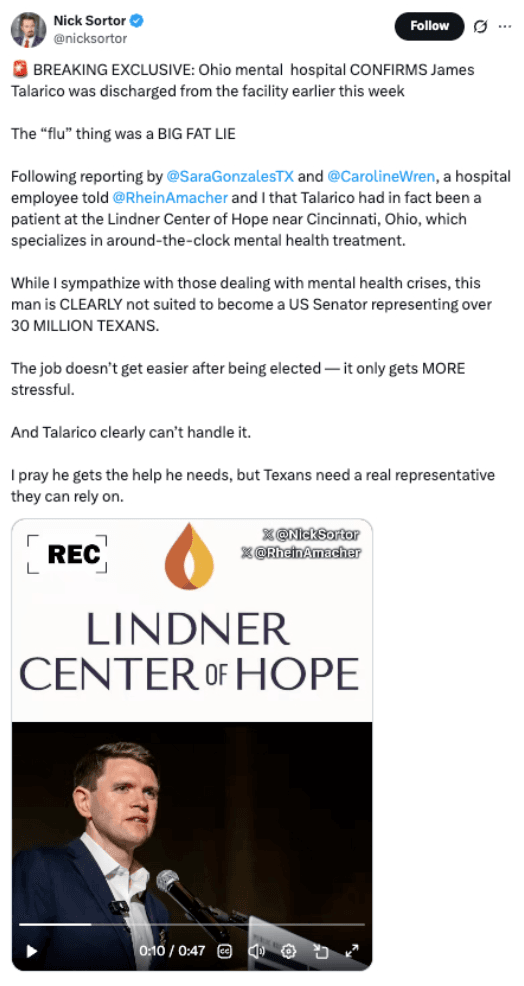
An audio recording shared on X, allegedly documenting that confirmation, was circulated as further proof. But the facility did not authenticate the recording and denied that Talarico had ever been a patient.
Despite that denial, conservative channels continued amplifying the allegations. Within hours, the conversation shifted from questions about Talarico’s whereabouts to attacks on his fitness for office.
One widely circulated Telegram message described the supposed hospitalization as “disqualifying” and declared Talarico “unfit to serve.” Posts promoting the allegations attracted thousands of views, with some individual messages exceeding 14,000 views.
The Spanish-language twist
As the controversy spread in English, conservative Spanish-language accounts on X and Facebook began promoting their own versions. Some went further than the original allegations, claiming without evidence that Talarico had attempted suicide.
The conservative outlet La Derecha Diario published an X post presenting the alleged suicide attempt and psychiatric hospitalization as facts. The post generated 985 interactions in a single day, according to NewsWhip.
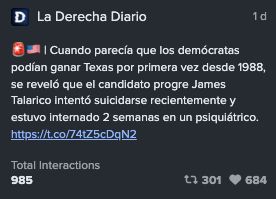
Reactions to it were divided. Among comments reviewed by our researchers, criticism of Talarico and Democrats slightly outnumbered responses rejecting the allegations or questioning the outlet’s credibility. Some users mocked the candidate’s mental health and called him “crazy.”
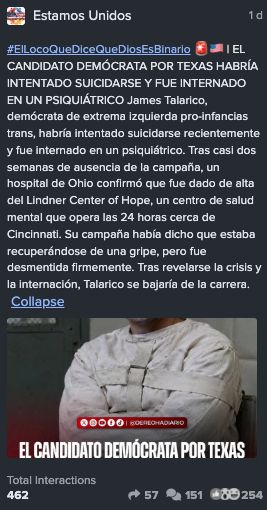
On Facebook, the account Estamos Unidos repeated the hospitalization allegations and introduced another unsupported claim: that Talarico was preparing to withdraw from the Senate race.
The post, which received 462 interactions in one day, also attacked his progressive positions on gender identity and included the hashtag #ElLocoQueDiceQueDiosEsBinario — roughly, “the crazy man who says God is nonbinary.”
October 13: Only yesterday (Oct. 13), some conservative English-language Telegram channels monitored by DDIA had begun questioning whether the allegations were fabricated. But instead of recognizing the disinformation, several right-leaning users shared a video examining whether conservative influencers had been deceived by false information passed on to them by unreliable individuals.
But by then, the story had already traveled across platforms and languages, acquiring allegations that went well beyond the original hospitalization claim.
Why does this matter: The Talarico case illustrates a recurring challenge in countering election disinformation, in that a false allegation can evolve as it spreads, making the original correction insufficient to address every version of the story.
Methodology: DDIA collected and analyzed social media and messaging apps raw data using NewsWhip and Open Measures. The data collection used to back this newsletter took place between Sep 7-15, 2026. All searches were conducted in Spanish and English.