This analysis examines the narratives and trends circulating in Spanish-language online conversations from 12:00 p.m. ET. on November 3, 2026, through 2:00 a.m. ET. on November 4, 2026.
Read our first report, covering the first 12 hours of November 3 (midnight to 12 p.m. ET), here.
Latino Social Media Celebrates Democratic Midterm Victories as Trump Accepts Results but Deflects Blame
Democrats' reported victories in yesterday's U.S. midterm elections sparked celebrations across Spanish-language social media, where journalists, politicians, and commentators portrayed the results as a major setback for President Donald Trump and his Republican allies. Many interpreted the outcome as a rejection of the administration's economic and foreign policies, while others questioned what Democratic control of Congress could mean for Latin America.
To understand these reactions, DDIA analyzed more than 1,000 public social media posts collected through Sprout Social from X, YouTube, and Bluesky between 12 p.m. ET on November 3 and 2 a.m. ET on November 4, 2026. The analysis focused on Spanish-language discussions about the election results, Trump's post-election statements, and their political implications. The posts revealed four major topics of discussion:
Celebrations of a Democratic "blue wave," particularly in Texas, accompanied by claims that Latino voters had turned against Trump over the economy and the war in Iran.
Mixed reactions to Trump's post-election statements, which combined an unusual willingness to accept Democratic victories and negotiate with congressional leaders with a refusal to take responsibility for Republican losses.
Islamophonic comments against El-Sayed, fueled by right-wing accounts and influencers.
Debates about the consequences for Latin America, with progressive profiles celebrating a setback for right-wing movements and conservative voices questioning how Democratic control of Congress could affect U.S. foreign policy.
Let's dive into each one of these findings:
A Democratic "blue wave" sparks celebrations and claims that Latino voters abandoned Trump
Celebrations of Democratic victories were prominent among the posts analyzed by DDIA, particularly those published by journalists, political figures, and commentators commonly critical of Trump.
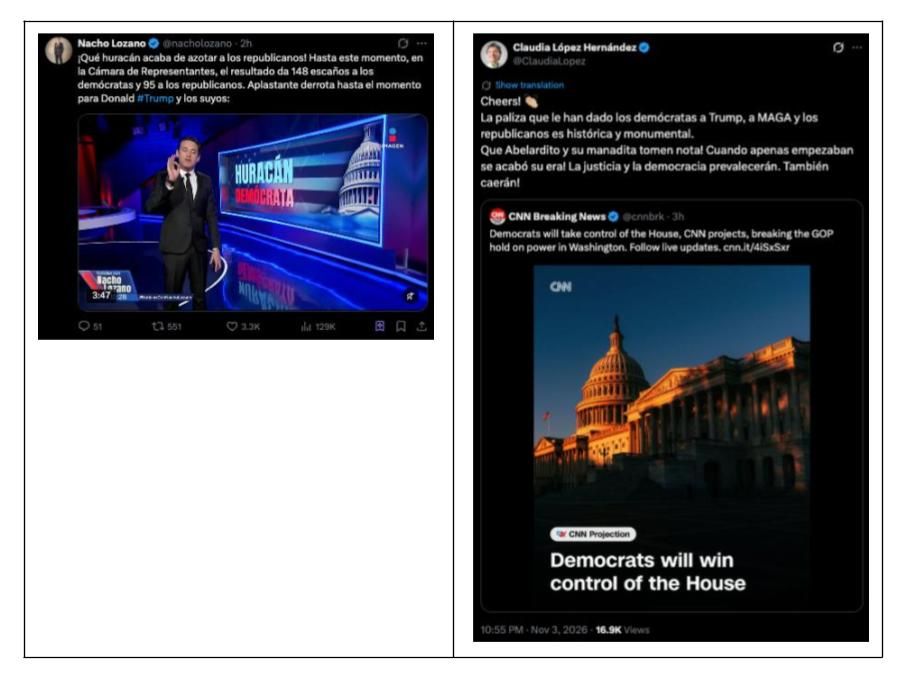
U.S. Latino as well as prominent Latin American voices with high followings among U.S. Latinos like Mexican journalist Nacho Lozano (474,000 followers on X), for example, captured the tone of the conversation with a question: "¡Qué huracán acaba de azotar a los republicanos!" ("What a hurricane just hit the Republicans!"). His post generated approximately 1294,000 impressions. And Colombian former senator Claudia López Hernández described the results as a "paliza histórica y monumental" ("historic and monumental beating") for Trump, MAGA, and the Republican Party, potentially reaching 1.44 million people.
In this universe, Texas emerged as a central symbol of the Democratic victories. Several posts reviewed by our researchers celebrated Democrat James Talarico win over Republican Ken Paxton in the U.S. Senate race, but also mentioned Gina Hinojosa over Republican Governor Greg Abbott. For Latino social media users, these outcomes were evidence that traditionally Republican states were becoming more politically competitive and should be carefully handled leading up to the 2028 presidential election.
Spanish journalist Guillermo Fesser, who has 160,000 followers on X, declared in all caps: "TEXAS IS BLUE." Citing early vote-counting data, he argued that Hispanic voters who had supported Trump in 2024 were shifting toward Democrats, and, in another post, celebrated: "Ding dong. The Trump era is gone," drawing enthusiastic responses such as "Parece que el mundo aún tiene esperanzas" ("It seems the world still has hope") and "Por fin una buena noticia" ("Finally, some good news").
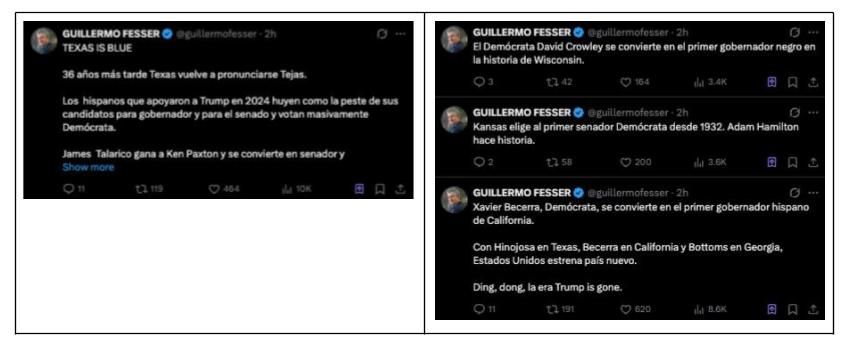
Other Spanish-speakers highlighted Democratic Senate victories involving Adam Hamilton in Kansas, Sherrod Brown in Ohio, Josh Turek in Iowa, Roy Cooper in North Carolina, and Annie Andrews in South Carolina. Together, these publications fueled descriptions of a historic political realignment.
But not all reactions were celebratory. Conservative Latinos argued that midterm elections frequently produce losses for the president's party and cautioned against treating the results as evidence of a permanent political transformation.
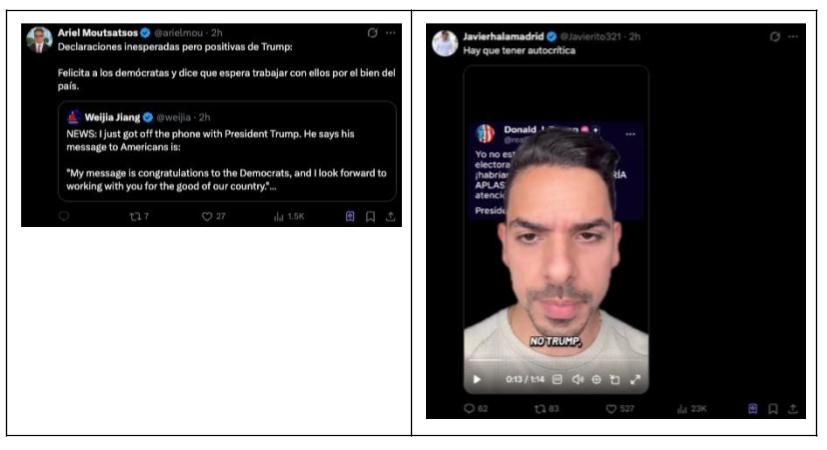
Others focused on the potential consequences for Latin America. JavierHalaMadrid (819,000 followers on YouTube), for example, argued that "no Democrat ever did anything for Venezuela," reflecting concerns among some conservative users that Democratic control of Congress could weaken U.S. support for anti-communist movements abroad.
Finally, many social media users with no clear political alignment attempted to explain why Republicans had lost support – and the cost of living was a recurring explanation. Posts circulated exit-poll figures on Bluesky claiming that nearly nine in ten voters considered living expenses a major concern and that roughly two-thirds blamed Trump's policies for rising prices.
Higher gasoline prices, the eight-month war in Iran, and U.S. military spending abroad were also mentioned by Latinos accusing Trump of prioritizing foreign conflicts while Americans struggled to afford basic necessities.
Trump accepts Democratic victories but refuses to take responsibility for Republican losses
President Trump's response to the election results generated a second wave of commentary, particularly after interviews and statements began circulating online after 10 p.m. ET.
The central point of the Spanish-language discussion was the contrast between Trump's willingness to accept the results and his insistence that Republicans would have won if he had been on the ballot.
In an interview with The New York Times, Trump was quoted as saying, "I am absolutely willing to accept these results." He also reportedly congratulated Democrats and expressed willingness to negotiate with the new congressional leadership.
The statements drew attention because of Trump's history of challenging unfavorable election outcomes and his previous remarks on election fraud. Mexican-American journalist Ariel Moutsatsos described them as "Declaraciones inesperadas pero positivas" ("Unexpected but positive statements"). JavierHalaMadrid recorded a video complaining about Trump's lack of self-criticism.
In a similar direction, Miami-based political analyst Javier Maza (30,000 followers on X) highlighted that Trump's vanity is probably preventing him from recognizing his responsibility for the losses, harnessing more than 40 likes in one hour.
Right-Wing Spanish-Language Media Fuel Anti-Muslim Attacks Following El-Sayed’s Michigan Victory
Abdul El-Sayed’s win in Michigan's Senate race split Spanish-language social media, according to data extracted from Sprout Social. On the hostile side, news media outlets tied to Spanish communicator Javier Negre led the way. On Election Day, Argentine-based La Derecha Diario amplified claims that lifelong Democrats were voting Republican “to prevent the victory of the Muslim El-Sayed.” After the race was called, Spanish-based UHN Plus claimed without evidence that the new senator aimed “to push sharia law and Islam,” and La Derecha Diario declared “the beginning of the end of the West.” Right-leaning Venezuelan content creator Emmanuel Rincón joined the conversation labeling El-Sayed's “the Islamist Democrat,” and individual users following him asked whether the U.S. had “forgotten 9/11.”

Comments left under these posts were mostly islamophobic – a risk that could potentially impact El-Sayed's work in the Senate throughout the next term. Replies to UHN Plus’s post largely echoed its framing. Commenters warned that Democrats would be “replaced by Muslims” as in Europe, calling Islam a “cancer” in Congress. DDIA spotted El-Sayed being mocked with stereotypes (that will not be reproduced here).
On the other side, the most-shared reaction of any kind came from Spanish journalist Fonsi Loaiza, whose posts hailing the first Muslim U.S. senator drew more than 20,000 interactions. Some users followed his train of thought, cheering the result as a blow to Trump. But most of the visible replies – potentially based in Spain as well – were still hostile, calling El-Sayed a “jihadist,” invoking Islam’s supposed threat to “the West.”
In Latin America, Colombian senator María José Pizarro and Mexican producer and commentator Epigmenio Ibarra celebrated El-Sayed's win, indicating that midterms were observed beyond borders.
Finally, DDIA also notice positive engagement coming from social media users in Honduras and Guatemala. Some of them merged El-Sayed's victory to James Talarico's win in Texas to call both of them “mis senadores” (my senators).
Latin American influencers interpret Republican losses through their own political battles
Posts from Colombia, Brazil, Chile, Mexico, and other countries connected the Democratic victories to broader debates about right-wing populism, U.S. foreign policy, and the influence of Trump-aligned political leaders.
For progressive content producers, the results suggested that conservative and far-right movements could face electoral setbacks. For conservative voices, they raised concerns about the future of U.S. support for political allies in the region.
Brazilian commentators were among the most visible Latin American voices in the dataset (potentially because of the country's recent presidential election). One of the most-engaged posts analyzed by DDIA came from Brazilian federal deputy Erika Hilton, who celebrated Republican defeats in Texas and suggested that the results could have political consequences for Eduardo and Flávio Bolsonaro, son of former president Jair Bolsonaro who ran away from the country and are now living in Florida.
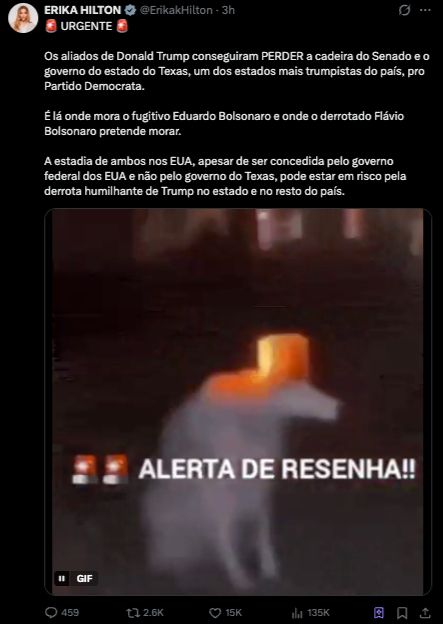
In Chile, congressman Ignacio Achurra argued that the Democratic victories showed that the advance of the far right is/was not inevitable. LIke some Brazilians had done, he also connected the U.S. results to political developments in Brazil and called for progressive movements to develop credible electoral alternatives.
Among Venezuelans, reactions reviewed by DDIA were more divided. Some questioned whether a Democratic Congress would maintain pressure on Nicolás Maduro's government, while others debated whether changes in Washington could alter U.S. policy toward Venezuela, indicating that the midterms are/will not be discussed exclusively as a U.S. political event. Latin American commentators will surely spend the next days trying to understand the impact of yesterday's results on their own nations.
False claims of election fraud surged in Spanish as U.S. midterm votes were counted
From fabricated FBI raids to seize ballots to misleading videos and fake voting instructions, Spanish-language misinformation spread across social media on Election afternoon and evening, targeting confidence in the 2026 midterms and the vote-counting process.
The narratives detected by DDIA using NewsWhip followed a recurring and well-known pattern: fabricated incidents, recycled footage and genuine technical problems were presented as evidence that the elections were rigged while polling stations were still open. Here is a brief recap:
Fake FBI raid in Texas alleges 20,000 fraudulent ballots: One viral claim alleged that the FBI had seized more than 20,000 fraudulent ballots favoring Democratic candidates in Houston, Texas, before Election Day. The story originated from an X account known for publishing satirical content but was subsequently circulated as factual information. As the allegation reached Spanish-speaking audiences, PolitiFact and Factchequeado debunked it, confirming that no such raid or ballot seizure had occurred. The case illustrates how fabricated stories can cross language barriers and acquire the appearance of legitimate election news.
Old California police video recycled as proof of fraud: A 2023 video featuring a California police officer discussing voter registration records resurfaced on Election Day, accompanied by posts claiming it exposed evidence of "rigged elections" in 2026. The footage was stripped of its original context and circulated in English and Spanish as if it documented current electoral misconduct. Fact-checkers found that the video did not substantiate allegations of fraud in the midterms. The tactic relied on repackaging authentic but outdated footage to lend credibility to a false claim.
Routine voting machine problems portrayed as systemic fraud: Technical disruptions at polling locations became another source of misleading allegations. DDIA identified cases in three states where operational problems were reframed by right-wing digital networks as evidence of election manipulation. In Westchester County, New York, scanner jams fueled fraud allegations, as we covered in part 1 of this analysis. In Georgia, scanner errors affecting 1,069 ballots were similarly misrepresented. And in Broward County, Florida, delays involving vote tabulators were portrayed as suspicious. Fact-checkers found that these technical problems did not establish electoral fraud.
Fake messages and signs mislead Georgia voters: Other misleading content went beyond questioning election integrity and provided voters with false logistical information. Hispanic media reported about Fulton County, Georgia, where deceptive text messages falsely informed voters that their polling locations had changed on Election Day. Media also picked up a story from Decatur, Georgia, where physical signs incorrectly claimed that early voting would continue through late November. Unlike general allegations of fraud, these messages (shared in English) risked directly interfering with participation by sending voters to incorrect locations or misleading them about voting deadlines.
Methodology
DDIA collected and analyzed raw data from social media and messaging apps using NewsWhip, Sprout Social and Open Measures. Platforms analyzed included Facebook, Instagram, X, YouTube, Bluesky, TikTok and WhatsApp. The data underpinning this analysis was collected between 12:00 p.m. ET, November 3 and 02:00 a.m. ET on Wednesday, November 4, 2026. All searches were conducted in Spanish and English.