A breakdown of the first 12 hours of November 3 (midnight through 12 p.m. ET)
NATIONAL
Westchester’s scanner failures drive Spanish-language Election Day conversation about voting machines
On the morning of the midterms, Spanish-language social media conversation about voting machines centered on the ballot scanner failures across Westchester County, New York, which includes the competitive 17th Congressional District. DDIA’s monitoring of the first 12 hours of Election Day (midnight to noon ET) found that the story spread mainly as news coverage, but some accounts are trying to frame the failures as evidence of potential fraud and “electoral chaos.”
The first Spanish-language reports appeared shortly after 9 a.m. ET, when Mexican outlet Ultrapuebla and Telemundo’s live blog flagged failures in Westchester voting machines. Over the next two hours, the story was picked up widely. Coverage came from Mexican media such as Imagen, Excélsior, N+ Foro and Latinus, and from U.S. Spanish-language newsrooms such as Telemundo and Univision Nueva York. Most posts gave the official explanation, pointing out that the county election board attributed the problem to an issue with the paper ballots that prevents the machines from accepting the ballots. Meanwhile, ballots were being stored in secure emergency bags to be counted later, and voters were asked to stay in line.
But some accounts went further. At 9:40 a.m., UHN Plus posted that Westchester was experiencing “caos electoral,” citing the board’s explanation alongside Republican Rep. Mike Lawler’s claim that all the machines were down. UHN Plus is a Miami-based outlet with more than 1.2 million followers on X. It is half-owned by Javier Negre, who also owns Argentina’s La Derecha Diario, and is president of programming at Real America’s Voice en Español, where he hosts “The Right News Show.” At 11:20 a.m., RAV Español’s X account (@RAVEspanol) used a similar framing:
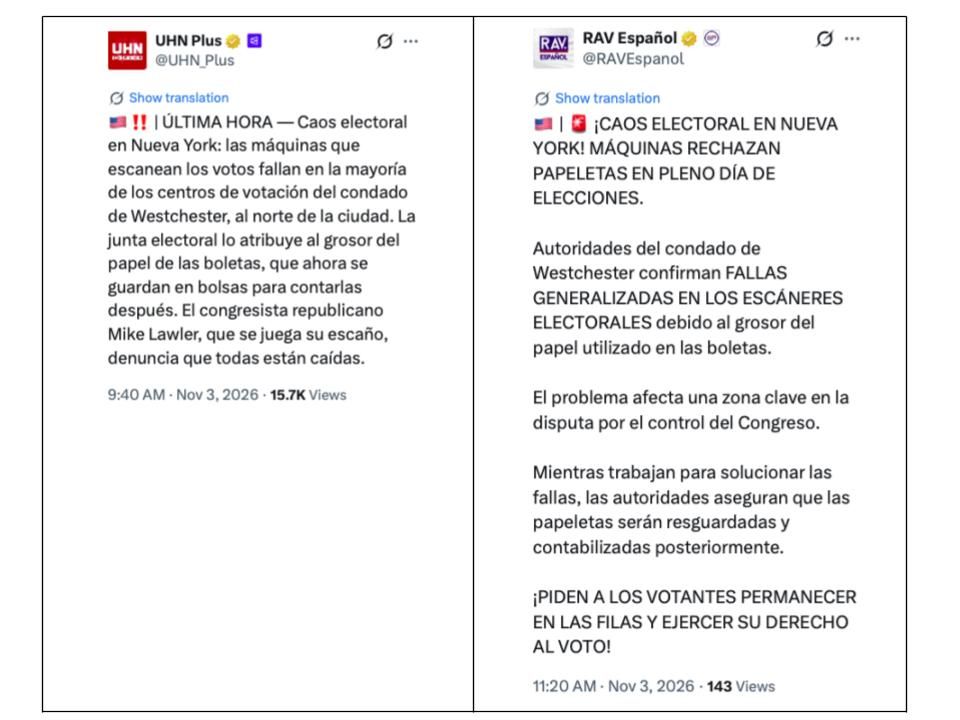
Spain-based Negocios TV (on X and YouTube), MexicoPost and Venezuela’s 2001 (@2001OnLine) also used “caos electoral” or “caos” in their headlines.

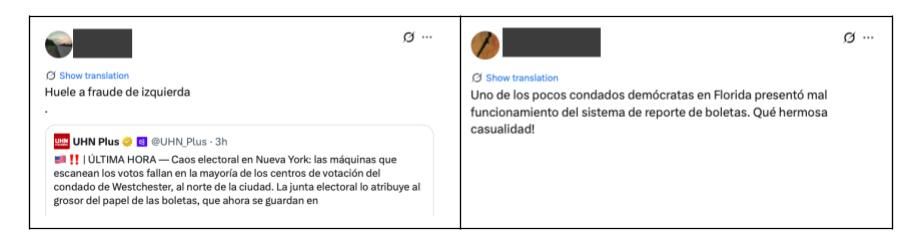
Some users responding to UHN Plus’ post said that the machine failure “smells like leftist fraud,” and another one called it a “beautiful coincidence” that Broward County, Florida, one of the state’s few Democratic counties, also had technical issues in the morning.
INTERNATIONAL
Venezuela’s state-owned teleSUR questions U.S. election integrity, citing research that does not cover the 2026 midterms
As Americans head to the polls for this November 3 midterms, Venezuela's state-owned broadcaster teleSUR is amplifying claims that U.S. elections cannot be trusted, echoing narratives promoted by Donald Trump and Russian-aligned voices that question the legitimacy of the U.S. electoral system.
In a video posted on X, teleSUR claims that U.S. elections lack transparency and reliability, citing the Electoral Integrity Project, an academic research initiative associated with Harvard University and the University of Sydney.
But the research does not support such a sweeping conclusion about the 2026 elections. According to the project's website, its available assessments cover elections only through 2024. Moreover, its findings are based on expert evaluations of people's perception on electoral integrity, not direct evidence of widespread fraud. Comparisons with established democracies also covered by the initiative, including Canada, Japan and France, also provide important context that teleSUR's presentation leaves out. They all have – more or less – the same level of public trust.

The potential reach is significant. Publicly reported figures have attributed an audience of up to 550 million viewers across Latin America to teleSUR and 50 million in the U.S.
SENATE
Religious attacks and extremism claims shape Senate race discussions in Michigan and Texas
Between midnight and noon (Eastern Time) on Tuesday, November 3, Midterms Election Day, Spanish-language online conversations about key Senate races in Michigan and Texas have focused on religious identity, ideological attacks and Democratic divisions. Conservative influencers and partisan outlets are driving much of the messaging – and potentially coordinating attacks against progressive candidates.
Data collected and analyzed by DDIA through Open Measures, NewsWhip and Sprout Social this November 3, 2026 up until 12 p.m. ET, shows that Michigan Democrat Abdul El-Sayed is facing a last-minute wave of anti-Muslim attacks, while Texas Democrat James Talarico is being portrayed as a progressive and dangerous extremist.
Michigan: Democratic divisions and anti-Muslim attacks
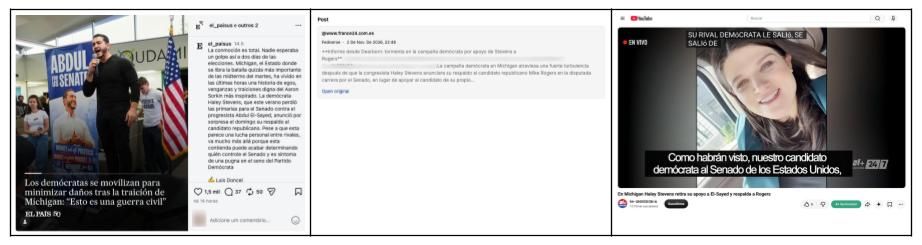
The Spanish-language conversation around Michigan's Senate race intensified this morning after Haley Stevens, who lost the Democratic primary to El-Sayed, endorsed Republican Mike Rogers in the wake of Election Day. Online commentators and news outlets like El País en Español and Univision described the dispute as a Democratic "civil war." The narrative pushes the idea that El-Sayed is anti-semitic and cannot be trusted for office.
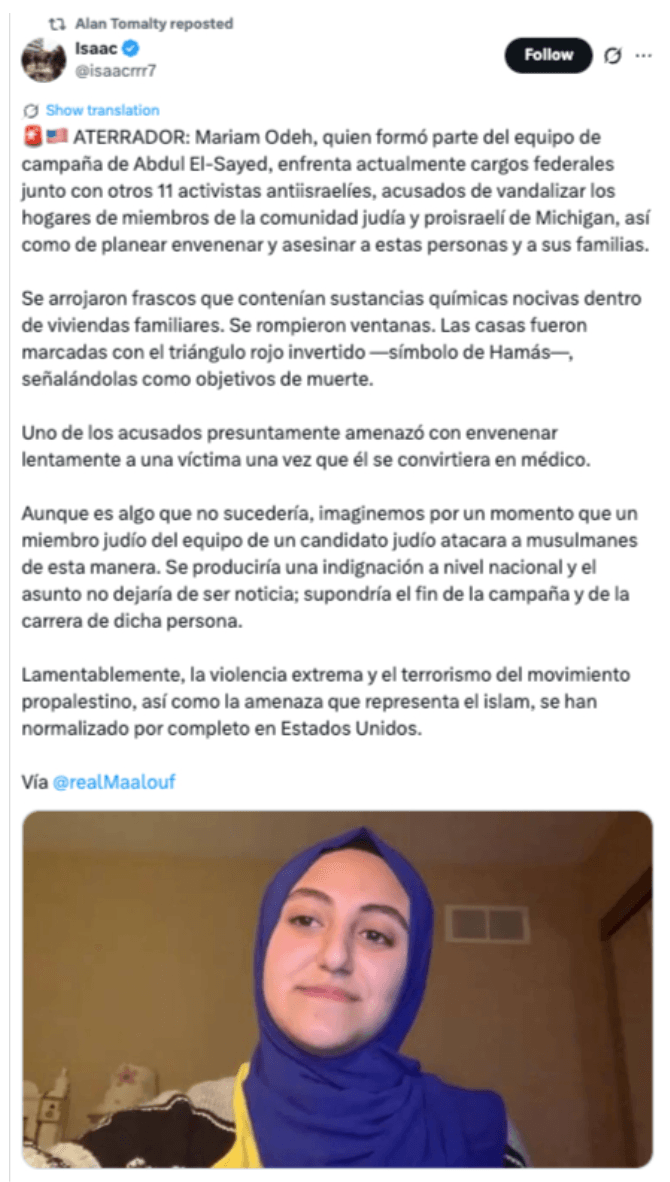
Meanwhile, conservative influencers and the Argentine-based outlet La Derecha Diario targeted El-Sayed's Muslim identity, portraying him as an extremist. The attacks mostly focused on Mariam Odeh, a former El-Sayed campaign member reportedly accused in a federal investigation involving 12 anti-Israel activists, and alleged threats, vandalism and intimidation against University of Michigan officials and others. In this case, DDIA identified at least four Spanish-language social media accounts sharing identical messages about Odeh, in a copy-and-paste amplification initiative to be further studied.
Texas: Talarico portrayed as a progressive extremist
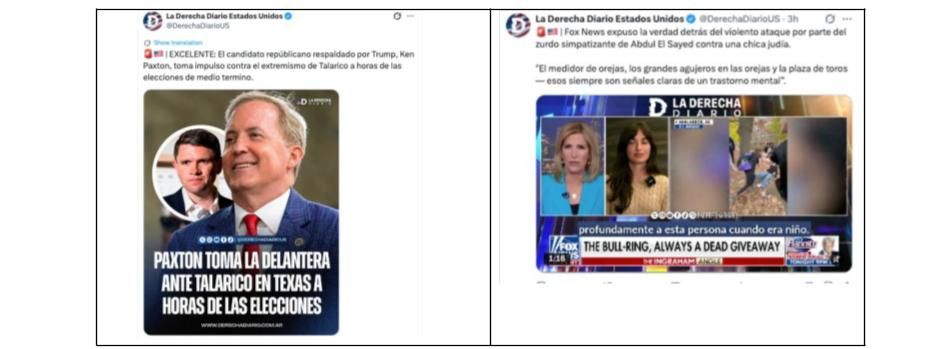
In Texas, conservative La Derecha Diario is also playing a role in the Spanish-language conversation. The initiative is framing the Senate race between Republican Ken Paxton and Democrat James Talarico as a battle against progressive "extremism." Rather than focusing on policy proposals, La Derecha Diario posts associate Talarico with controversial progressive positions (like opening the U.S. border for all), reinforcing ideological divisions. It also reports (with no sources or evidence) on Paxton potentially being ahead of Talarico in the polls.
HOUSE
Cost of living, and mail-in ballots drive House race discussions in Florida and California
Spanish-language conversations about key House races in Florida and California are focusing on affordability and election integrity this Tuesday. Unlike Senate race discussions, where ideological attacks dominate, the Spanish-language Latino conversation regarding new House leaders emphasize economic concerns and political accountability.
California: 20,000 mail-in ballots at the center of debate
Major Spanish-language broadcasters like Noticias Telemundo and N+ Univision highlighted a U.S. Supreme Court decision blocking efforts linked to Donald Trump and Republican challenges to discard 20,000 mail-in ballots in California. The Supreme Court ruled the ballots should be counted. Both networks framed the ruling as a significant victory for voting protections, bringing disputes over mail-in ballots and election integrity to the forefront of Spanish-language election coverage.
Florida: Cost of living and younger voters
In Florida's 27th Congressional District, Republican incumbent María Elvira Salazar and Democratic challenger Eliott Rodríguez are competing for younger voters this Election Day, with Gen Z mobilization and rising living costs featuring prominently in last-minute campaign messaging.
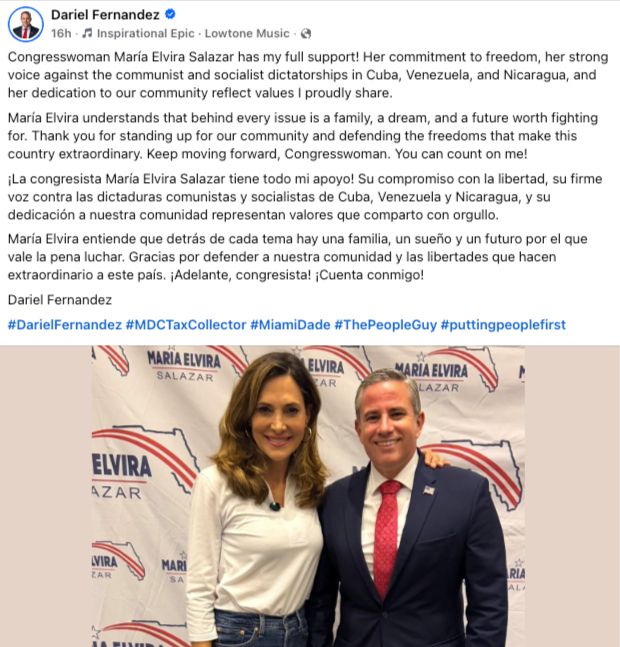
Salazar worked to mobilize conservative Hispanic voters by leaning into a strong anti-communist and anti-socialist platform targeting the regimes in Cuba, Venezuela, and Nicaragua. Her campaign relied up until today on community endorsements (such as Miami-Dade County Community Council Board Member Dariel Fernández) highlighting family values, individual freedom, and local community defense to drive turnout.
Rodríguez, on the other hand, focuses mobilization efforts on maximizing mail-in ballot returns and swaying undecided and non-affiliated voters in Miami-Dade to close the early voting gap.
Methodology
DDIA collected and analyzed raw data from social media and messaging apps using NewsWhip, Sprout Social and Open Measures. Platforms analyzed included Facebook, Instagram, X, YouTube, Bluesky, TikTok and WhatsApp. The data underpinning this analysis was collected between 12:00 a.m. ET and 12:00 p.m. ET on Tuesday, November 3, 2026. All searches were conducted in Spanish and English.